



OMAHA — Physically The Tent, one of three new church starts in the Great Plains Conference, is actually a sturdy building in south Omaha, constructed as a synagogue and used by various denominations — and even for a short while as a nightclub — in its history.
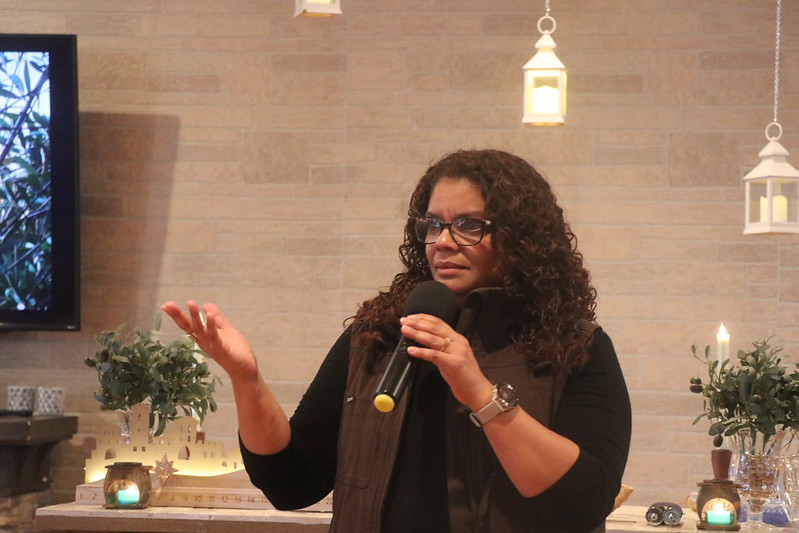
Metaphorically The Tent, a collaboration of United Methodist and Lutheran congregations, opens its flaps wide for inclusion of first- and second-generation immigrants, LGBTQ congregants, suicide prevention programs, its multicultural community and is described by its pastor, Diana Fajardo, as a “theater church,” with a rack of costumes in the storage area behind its sanctuary space.
“What we’re trying to do is help people really get an idea of Gospel and Gospel context, and for them to gain their own reflection,” she said. “We have one Sunday of the month where people come, we hand over the costumes, and they don’t know what the Gospel is going to be. The reflection comes from them, how they felt with the authority.”
Fajardo, who was born in Colombia, is in the process of earning her Master of Divinity degree from Perkins School of Theology at Southern Methodist University. She alternates with her husband, Rev. Omar Vila, a native of Peru and ordained Lutheran pastor, in leading the weekly services at noon Sundays at the church, officially known as Iglesia Luterana San Andres. (Vila was not at The Tent this day, tending to his ill father in Peru.)
Those Sunday services are bilingual, Fajardo said, because in the congregation there are five engaged couples, each with a partner who doesn’t speak Spanish.
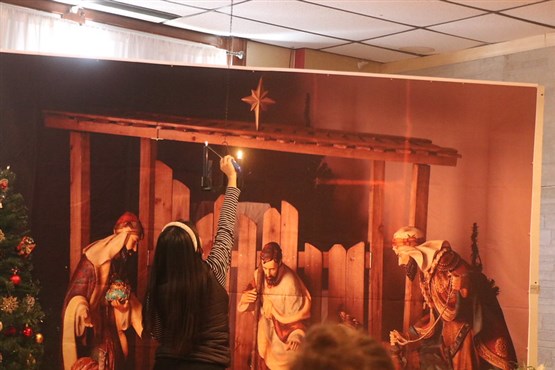
The Advent candles were hung from the ceiling, ostensibly lighting the stable scene of Mary, Joseph and baby Jesus in a large backdrop behind it.
Fajardo’s sermons are as much teaching as preaching, asking questions during her sermon and expecting insight and answers from the congregation.
“This is a space for theological development. You have to have that basis,” she said. “Culture doesn’t have that. You don’t have that being a Catholic.”
Fajardo was raised Roman Catholic, and Vila was in the process of becoming a Catholic priest when they met in Miami
“I did not steal him,” she said with a laugh.
She wants to see those in The Tent grow as Christians.
“When we talk about worshipping, this is where we say we grow theologically. This is not about denomination. It’s about finding out who we are as children of God,” she said.
“Finding that identity first, before finding an identity that’s denominational, is very important. The Latino community, the immigrant community, they’re not Methodist. They’re not Lutherans. There is a majority of Roman Catholic.
“I know the process, and I know how shocking it is to want to become a member when you have no clue what that means,” she added. “Many times you feel left out. You think you’re doing good and everybody’s looking at you like, ‘That’s not the way.’ That creates an opportunity to be a new church.”
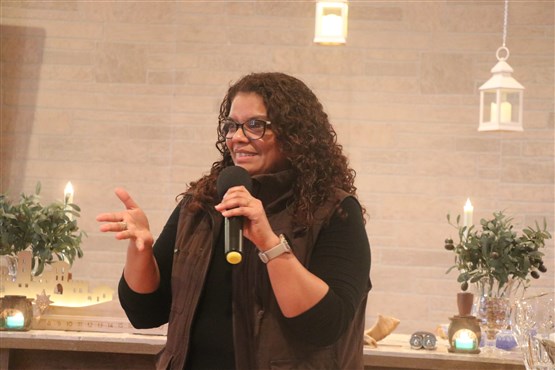
The number of worshippers at The Tent varies greatly from week to week, Fajardo said. On this Sunday it began with a half-dozen with three more arriving in the next half-hour, two of them for the first time.
“We are few, but we are many in heart,” she said as the service opened.
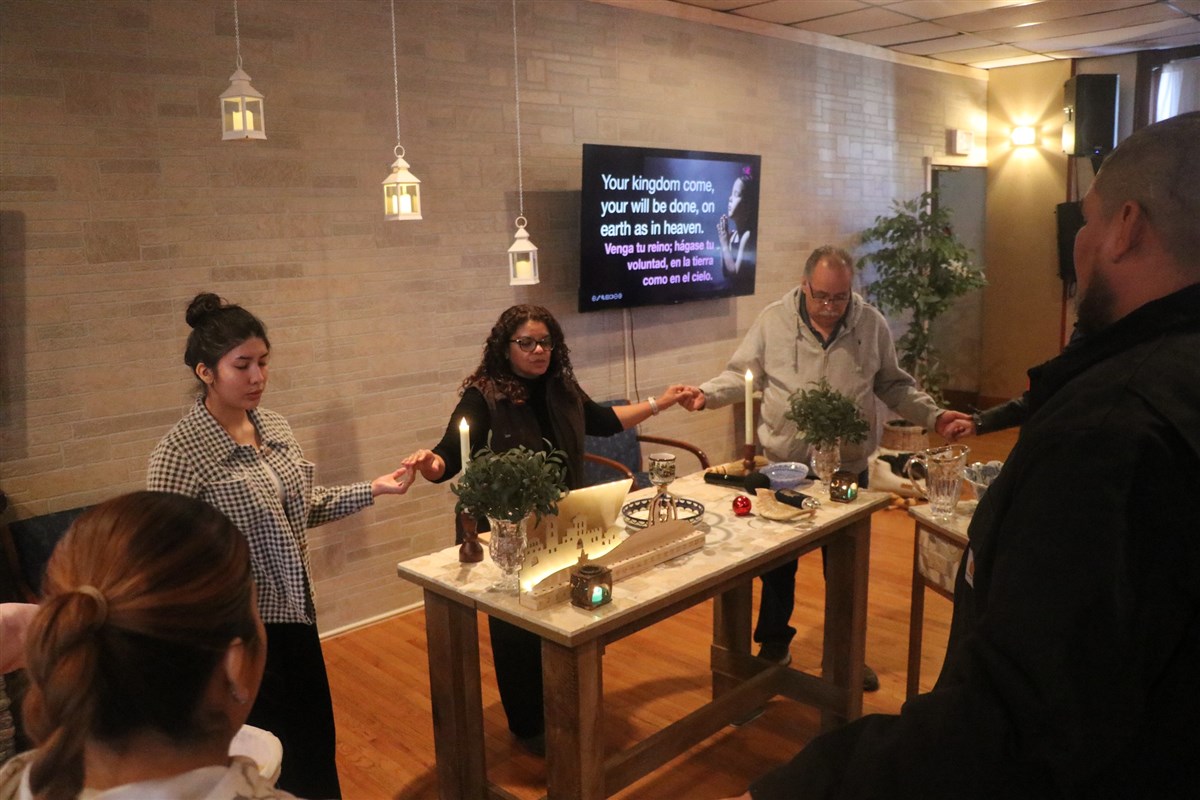
Under subdued lighting, the congregation sings and reads liturgy in two languages. For communion, everything gathers holding hands around the table, taking turns picking a wafer from the basket to dip in the chalice.
But like other churches, at 16 months old, The Tent doesn’t pull its stakes after Sunday services have completed.
Its burgeoning food pantry program has grown from 125 families to more than 200 in the time it’s been open, backed by several grants, including one from the United Methodist General Board of Global Ministries.
And in March, it’s scheduled to open a Montessori school, with a goal of eight pupils up to age 4. Plans are for an additional school for ages 4-6, then another for ages 6-12.
“It’s a program where kids are able to learn and explore in a different learning style to help them to grow and be more independent in themselves,” said Emily Sanchez, a political science major at the University of Nebraska-Omaha and one of two students receiving scholarships from the church to teach at the school.
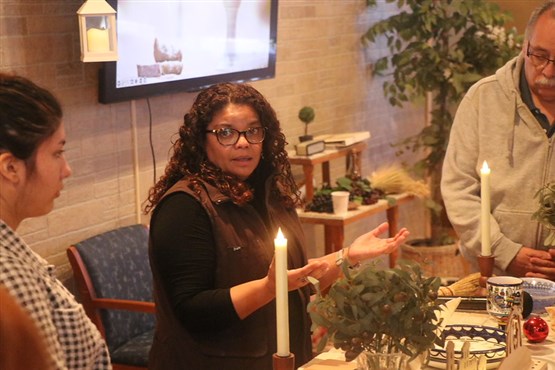
Fajardo said the Montessori program was needed in that part of Omaha, where a majority of residents are immigrants working in meatpacking plants, and their families are at a disadvantage entering school.
“When a child is born in this community, they’re the ones having a hard time,” she said. “When a child comes to a school from a Latino family or any other culture that is not American, they are (labeled) ‘In need of progress,’ and that takes away a lot of possibilities for that child in the system.”
While education for immigrant children was a great need, so was support for suicide prevention and for LGBTQ residents, services which were not provided at the numerous other churches in the area.
“This is just different, it’s unique and it’s a place that makes you feel like you’re welcome and you belong no matter where you come from and what your feelings are. You’re just welcome here,” said Camila Silva, the other projected teacher for the Montessori program, who works as a nanny and is studying business administration at Metropolitan Community College in Omaha.
The Tent provided a lending library of LGBTQ resources outside its doors at the corner of South 25th and J streets, but vandalism forced Fajardo to move the library indoors.

The Tent is a two-minute drive, four-tenths of a mile, from Iglesia Communitaria, another growing Hispanic United Methodist Church in south Omaha.
“If you drive around the neighborhood, there is a church in every block. We thought about that a lot,” Fajardo said. “We are constantly changing for the needs of the people, and they are more of a traditional church. They’re both necessary, because not everybody is looking for something that changes all the time. They want tradition as well, and there’s a place.’
When Fajardo first submitted her plans to the Great Plains Conference’s New Church Development committee in 2024, she had no idea how the climate would change for immigrants in Omaha and nationwide. Now she has to contend with the thoughts of her church members — even herself and her husband — facing U.S. Immigration and Customs Enforcement.
“ICE has to go through me,” she said.
Although it has not happened, ICE agents are not allowed in the building. They must request who they are looking for, and she may escort that person.
“It’s a very real thing, especially now that things change so fast,” Fajardo said, noting that work permits are now valid only 18 months, compared to the previous five years.
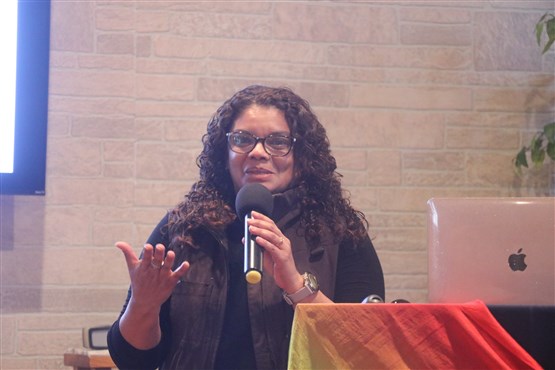
Many of The Tent’s Sunday services include an update on ICE and news about immigration.
“We try to connect people with reality for the ones who do not watch the news,” she said. “It’s the fear of not knowing. This is a safe space for people to be informed — here is the bad news, but here is the Good News of the Gospel that God is here.”
Fajardo said she lives in fear for herself and her congregation.
“My biggest concern is how can you lead when you’re also a target? As pastors, we lead from a certain place of privilege, but not nowadays,” Fajardo said. “I am considered a second-class citizen because I am naturalized in this country. I have to always go out with my passport in hand.
“They don’t know the human beings,” she added. “They are trying to demonize a group of people with their power and money, and that’s just not fair.”
Fajardo said she is doing her best to shepherd her congregation.
“There are many social issues where our people don’t have resources, the same things every family faces,” she said.
With a nearly constant smile, Fajardo said she loves her calling to serve the church.
“I don’t see myself doing anything else,” she said. “I was aware of my calling since I was 12 years old. To me it’s still a journey, and I don’t think I’m there yet. I don’t think ordination is the ultimate goal. I’m still learning. I’m a piece of work, and the Good Lord is making it work with me and everyone here.”
Contact David Burke, content specialist, at [email protected].